Sunday, July 26, 2015
THE OUTLIERS
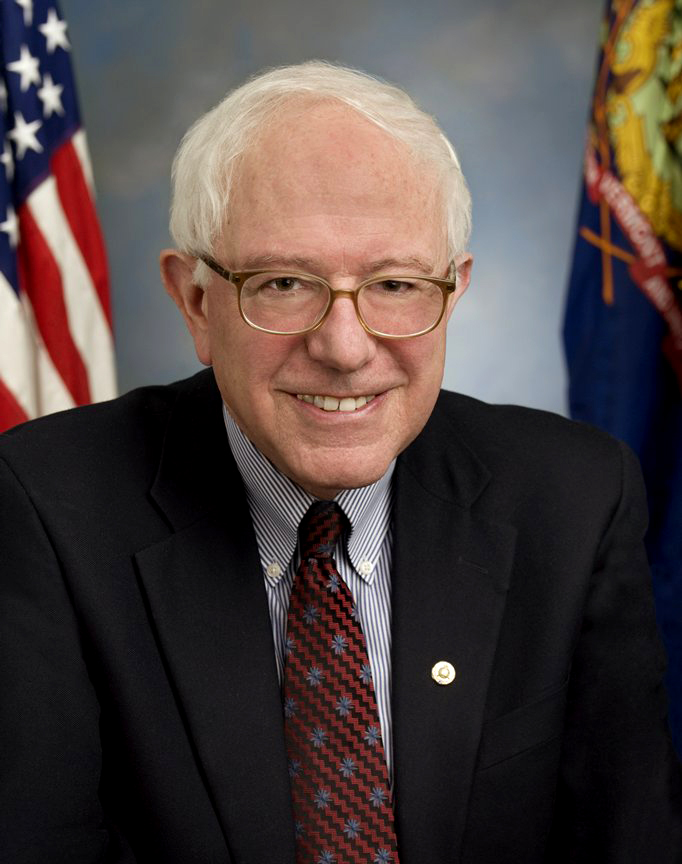
Recently, the absurdly premature and mostly dull 2016 presidential campaign (which may seriously result in a Bush versus a Clinton!) has become more entertaining by the emergence of two candidates from both parties who are pushing buttons on both the left and the right: first, there's Senator Bernie Sanders. Although technically an independent, Sanders has decided to run against Hillary Clinton for the Democratic Presidential nomination. The Vermont Senator is the only member of congress to proudly call himself a European style Socialist, and his populist message of dealing with the nation's great issue of economic inequality has caught on. The number of people at his rallies has steadily increased, as has his ratings in the polls. With his often unruly crest of white hair and frequently hectoring style of speech, Sanders often comes across as part Old Testament prophet and part crazy uncle (if your uncle were left wing), and at almost 74 years old he's probably too old to put in a serious run for the presidency. Given all that, I'm still a big fan of the guy, especially when he honestly states that he thinks America can improve and learn from European Socialist ideas, and if he pushes Hillary Clinton into adopting more progressive views, all the better. Clinton has, for the most part, mostly ignored Sanders, which makes sense: despite his surge in the polls, she still retains a healthy lead over him and all the other Democratic candidates. Not to mention the fact that, sadly, the very thing I like about Sanders over Clinton is what will doom his quixotic campaign: he has turned down all Wall Street and corporate campaign donations, and, after the misguided Citizen's United Supreme Court ruling, raising hundreds of millions of dollars from wealthy donors is the only way to the white house in our modern system. And Clinton already has a huge money machine running that she could drown Sanders in if she needs too, and that should end things.
Or will it? Being an independent, is it possible that Sanders will run as a third party candidate? I certainly hope not. I can still remember what happened in the crazy 2000 presidential election when Ralph Nader ran as a Green party candidate and succeeded to siphon enough votes away from Al Gore to give the white house to George W Bush. I myself voted for Nader because after 8 years of Bill Clinton going along with the Republicans on one issue after another, I felt there wasn't enough of a difference between the parties. I now see the error of my ways! Bush was far more conservative than Clinton, and the damage his presidency did to both the country and the world are still being felt. So while I'm an admirer of Bernie Sanders, I sincerely hope that he doesn't push the election towards whatever Republican candidate is running.

Ah, and then there's Donald Trump, the loud mouthed, boastful man who has elbowed his way into the Republican candidate clown car through sheer force of will and ego. Amazingly, this real estate and media mogul who has never held any political office ever is working his way to the top of the polls over the 15 other Republican candidates running. His main claim to fame is that he is a rich, successful businessman, which of course has nothing to do with running a country and ignores the fact that he's declared bankruptcy more than once.
But that's not the worst of it. The real horrible thing about him is why he's leading in the polls. During his campaign announcement speech Trump made this inflammatory, offensive and factually incorrect statement:
"When Mexico sends its people, they're not sending the best..they're sending people that have lots of problems and they're bringing those problems. They're bringing drugs, they're bringing crime. They're rapists and some, I assume, are good people(!), but I speak to border guards and they're telling us what we're getting."
Sadly, these statements, no matter how false, represent the racist and xenophobic attitudes of many people in the Republican party. His current popularity shows that. And that fact that most of the other Republican candidates have given only tepid criticism at best over these comments reveals that they all know it. Which may spell doom for the future of the party.
It's hard to believe, but it wasn't always this way; after Barak Obama won reelection in 2012, partly due to the fact that he got a whopping 77% of the Latino vote, there was a movement in the Republican party to compromise on the issue of immigration reform, simply out of self preservation. Wise party members realized that alienating the fastest growing demographic members of the country amounted to political suicide. But nothing happened, and three years later and here's Trump with a razor blade to the party's wrist. And he's exactly what the Republicans deserve. While Trump's candidacy may bring back memories of Ross Perot, the billionaire who ran for president back in 1992 with a similar platform of wealth = power, I also can't help but be reminded of David Duke, the former Grand Wizard of the Klu Klux Klan who was briefly popular in the in the 1990's in the Republican party, much to it's chagrin. (As Duke himself was proud to point out, when he ran for the office of Governor of Louisisana in 1991, he won a majority of the white vote). Although Trump's personal history isn't as loathsome as Duke's, like Duke, Trump isn't really saying anything that other Republicans aren't saying, he's just more blunt about it. The fact of the matter is that, it is now as it was in the 90's, Republican presidential candidates can't win the party's nomination without playing up in some part to it's base of white Southern men who grew up at a time when segregation was the law of the land and who miss those good old days. Look, I don't want to say that all older white Southern men in the Republican party are racists, but at the end of the day, the proof is in the poll numbers.
Sunday, July 5, 2015
3 SIMPLE IDEAS
Ok, let's take a break from politics for a moment and talk about common sense. Here are three things that America could change about itself that would make the country better, and that, for some dumb reason, we can't seem to do.
#1. STOP JUMPING BACK AND FORTH WITH DAYLIGHT SAVINGS.
Daylight savings first began around a hundred years ago as a move to preserve daylight and save fuel. It began in Germany and is now used in 70 countries around the world, including, of course, the US. While it may have saved some fuel a long time ago, we live in a much different world now (for example, an extra hour of sunlight in many places means an extra hour of using air conditioning). Even worse, that lost hour of sleep makes a difference: every year the number of car and work related accidents go up the week after the "spring forward", and worker productivity goes down. Although the percentage of change on these things is small, so what? Isn't avoiding any increase of potentially dangerous accidents a good thing? So why go back and forth? Why not pick one time setting and stick with it? This seems to be one of those things that has been going on for so long that most people just accept it and don't much think about it. But it's just plain silly. One argument I've heard against keeping daylight savings year round is that kids will eventually have to go to school in the morning in the dark, which leads to my next point...
#2. QUIT SENDING KIDS TO SCHOOL ON FARMER'S HOURS
Making schooling mandatory began as far back as 1852 in the US. To accommodate the fact that many students lived on farms and needed to get home early to help out, schools began and ended at early hours. To this day, most schools follow the schedule of starting between 8-8:30 AM and ending between 3-3:30 PM. But most children today don't work on farms, and this set in stone schedule is hurting our educational system overall. Although the effort of getting up early is not such a burden on younger children, it's very difficult for teenagers. Multiple studies have shown that teens need more sleep than adults, and that they are essentially programmed to stay up late and sleep in. Over the years, when attempts have been made to push back school schedules for teens to deal with this, the results have been positive: according to the Center for Public Education's website, pushing back the school day results in higher attendance, less sleeping in class, and even less student depression. Not to mention the fact that teens tend to get in the most trouble in that time period after school before their parents get home, when there's no real adult supervision of them. Pushing back school hours would for less unstructured time for teens and less general chances for mischief. Now making this change would require teachers, school administrators and custodians to alter their own work schedules, but since happier students would make their jobs easier, I don't see why they should object to it so much. So, once again, why not do something that would clearly have a positive benefit?
#3. SWITCH TO THE METRIC SYSTEM ALREADY
Recently. long shot Democratic presidential candidate Lincoln Chafee mentioned something in his campaign launch speech that was a bit surprising: "Here’s a bold embrace of internationalism: let’s join the rest of the world and go metric".... "Only Myanmar, Liberia and the United States aren’t metric and it will help our economy!" He was inevitably mocked for bringing up an issue few Americans feel strongly about. And yet he had a point. The metric system is an easier and more logical system than our current one(often called the British Imperial system), yet we cling to it except for a few things here and there(like in the pharmaceutical industry). Part of our rejection of the metric system comes from the fact that it was developed by the French in late 1700's at a time when French-American relations were not good. Centuries later, in the 1970's, there was a definite attempt to convert America to metrics (I can remember TV commercials promoting it from my childhood). Laws were passed, but because they were voluntary, little changed. Part of the problem is that there would be some expense involved in altering maps and such, but the main reason seems to be what some people call "American exceptional-ism". That is, the strong, often stubborn feeling Americans have that we have to be different. Just as Americans shrug their shoulders at thousands of hand gun deaths annually as "the price of freedom", so do they defiantly resist a system of weights and measure used by other countries. But the metric system is better, and our continued usage of our outdated system often puts the country at odds with others. In an amazing example, back in 1999 NASA lost a 125 million dollar Mars orbiter because Lockheed Martin, the company that created it, used the American system while NASA used the metric system, causing confusion. Can't a waste of over a hundred million tax dollars because of flummoxed rocket scientists be seen as some kind of clarion call for the country? Apparently not since it happened over fifteen years ago.....grrrr!
A
recent study from Northwestern University builds on this research,
finding that high school students performed better later in the day than
early in the morning, and most high school schedules contribute to
sleep deprivation among students (Tonn, 2006). - See more at:
http://www.centerforpubliceducation.org/Main-Menu/Organizing-a-school/Copy-of-Making-time-At-a-glance/Making-time-What-research-says-about-re-organizing-school-schedules.html#sthash.ObShZR0n.dpuf
A
recent study from Northwestern University builds on this research,
finding that high school students performed better later in the day than
early in the morning, and most high school schedules contribute to
sleep deprivation among students (Tonn, 2006). - See more at:
http://www.centerforpubliceducation.org/Main-Menu/Organizing-a-school/Copy-of-Making-time-At-a-glance/Making-time-What-research-says-about-re-organizing-school-schedules.html#sthash.ObShZR0n.dpuf
A
recent study from Northwestern University builds on this research,
finding that high school students performed better later in the day than
early in the morning, and most high school schedules contribute to
sleep deprivation among students (Tonn, 2006). - See more at:
http://www.centerforpubliceducation.org/Main-Menu/Organizing-a-school/Copy-of-Making-time-At-a-glance/Making-time-What-research-says-about-re-organizing-school-schedules.html#sthash.ObShZR0n.dpuf
Monday, June 29, 2015
A DOUBLE BLAST OF COMMON SENSE
Here's a few words I thought I'd never say: Rush Limbaugh posted something on Facebook recently that was genuinely honest and insightful. He wrote:
"Now that I've outgrown the 25-54 demographic, I'm no longer confident that the way I see the world is the way everybody else does. I've gotten old enough now that there are younger people, generationally(sic) younger, who have an entirely different view, an entirely different experience."
It's truly surprising to find someone who has gotten very wealthy off mean spirited, thinly veiled racist, sexist and homophobic attacks admit that his time has passed. While I wish it had happened sooner, I'm glad that it's happened and that he and other extremist right wing media figures will slide into irrelevancy.
![]() |
| The face of reason, for once |
And no recent events confirm Limbaugh's prediction better than the two Supreme Court rulings that have just come down. First, on June 25th. Obamacare was once again spared in a 6-3 vote. This ruling was a bit surprising because many conservatives felt that Chief Justice John Roberts was going to "redeem" himself by gutting the same law that he voted to uphold in the first ruling on Obamacare years ago. Instead, not only did he vote for it but so did swing vote Justice Kennedy, making it not even close. The case was based literally on a typo in the bill that because of various legislative maneuvers in congress, could not be easily fixed. While the Supreme Court never should have heard this case in the first place, upholding the Affordable Care Act is a good thing. While some improvements clearly should be made to Obamacare, the fact of the matter is that millions of Americans now have healthcare because of it.
And the Obamacare ruling was followed by an even bigger decision: the US has now joined twenty two other countries in making gay marriage legal. This great blow for common sense equality is a stunning turn around for the country. It's amazing to think that just 11 years ago, with the Iraq war crumbling, George W Bush was sadly able to squeak out a reelection victory by using gay marriage as a wedge issue. And now the tide has turned, and a majority of the American public agree with the court's ruling. Conservatives can yell all they want, it's a new day of equality in America.
And then there's the Confederate flag; in the wake of the horrific shootings of 9 innocent people in South Carolina, the fact that the shooter Dylann Roof had pictures of himself holding the Confederate flag and posted a racist tirade online caused many politicians to reconsider the waving of a flag that, to many people, remains a symbol of bigotry. Surprisingly, even Republicans like South Carolina Govenor Nikki Haley and Senator Lindsay Graham have said that the flag should be taken down. This conversation is long overdue: although it's perfectly fine for someone to wave that flag on their own property, having it in front of government buildings sends an ugly message. Amazingly, the movement to remove it has been swift and overwhelming, with social media outlets swamping the state government, and even corporate groups like the South Carolina Manufacturers Alliance support the removal. For years white southerners have argued that the flag is just a symbol of rebellion and pride, but that argument seems weak given Roof's and other white supremacists embrace of it. While I wish the tragic shooting could have resulted in some common sense gun control, if bringing down the flag springs from it, then at least there will be an important symbolic change. It's time for the South to admit the Civil War was about slavery and the right side won. And that was over a hundred years ago. Get over it.
Tuesday, June 23, 2015
HOW MANY TIMES?
In the aftermath of the horrific killing of nine innocent church goers in South Carolina, a question arises and remains unanswered: How many times? How many times will we hear about the mass shooting of innocent people and do nothing? Why does America allow easy gun access to dangerous people? How long will the National Rifle Association continue to have a strangle grip on congress?
While this current shooting raises other ugly issues (like racism and the confederate flag) let's look at the issue of gun control. Groups like the NRA who oppose even the slightest kind of control point to the Second Amendment of the Constitution as the absolute bench mark of freedom. While that amendment does say that American citizens have "the right to bear arms", just how that was supposed to be inferred is up for debate. Some pro gun control groups have claimed that this was only in regards to individual states needing to have a militia. But the NRA, or course, maintains that the country's fore fathers opposed any limits on gun ownership.
Personally, I don't think that we can ever really know exactly what our fore fathers intended, and honestly, I don't really care. It bothers me that some people look at our constitution the same way that fundamentalist Christians look at the bible. Many of our country's founding fore fathers had slaves. None of them thought that women should vote. Were they just products of their time? Sure, but that's just the point, times change. There was no way that they could, in their time, foresee and understand the invention of weapons like assault rifles, not when they lived in an era of single shot flintlock weapons. So why does their feelings about comparatively primitive rifles matter in an era of bigger, faster, deadlier guns?
Now I personally hate guns and would never own one, but I am also a realist; the American gun culture is too strong in many parts of the country for any kind of an outright ban on hand guns to work like they have in many other countries. There are just too many people who will refuse to follow the law, which would result in the government having to enforce it with often deadly results.
But I don't see why every gun owner shouldn't have to get a license and register their gun the same way that we have to with our cars. Having 16 year olds have to pass a written test and then a driving test before they get a license, which then has to be renewed every few years seems perfectly rational. Why can't we do the same thing with guns? If a car driven by an unlicensed driver is dangerous, isn't a gun owned by an unlicensed owner also dangerous?
The answer that's usually given is that licensing guns would be the first step to taking them away, even though there is no proof of that. A law banning all guns would have to pass congress, and the NRA is one of the most powerful lobbyist groups in the country, so there's little chance of that happening.
Along with opposing even the weakest kind of gun laws, the NRA also fans the flames of fear by telling their members that whenever a Democratic president is in office, the government is just waiting to send in government thugs to take their guns away, even though the only gun control legislation that president Obama has tried to pass was a simple expansion of already existing background checks to include guns bought at gun shows. And even that went down to defeat. So the idea that Obama, or any Democrat wants to crack down on "law abiding gun owners" is absurd.
Equally absurd is the idea that the people of America need to have guns to overthrow the government. The idea that a bunch of citizens with guns could storm the nation's capital and somehow defeat a president protected by the largest military in the world is laughable. Even more ridiculous is the notion that people taking over the US government through force would be a good thing. Just look at history: in the twentieth century there were quite a few examples of people violently over throwing their national governments all around the world. Were any of them an improvement? The Czars in Russia were overthrown and replaced by the Communists, which lead to the brutality of Joseph Stalin. Batista in Cuba was overthrown and replaced with the dictator Fidel Castro. A CIA backed coup in Iran led to the ousting of democratically elected leader Mohammad Mossadegh and the installing of the Shah of Iran, who got rid of elections; he was himself violently over thrown and replaced with the current repressive Mullah government. And I could go on. I think it's safe to say that Government rule through violence is generally not a good thing in the modern world, despite what the NRA says.
And don't forget, although the NRA claims to be an organization made of gun owning citizens, every year gun selling companies donate millions of dollars to the group, seeing any limitation on gun sales as an cutting into their corporate profits. Yes, at the end of the day the NRA opposes common sense gun laws because their major donors want to reserve the right to profit from selling guns to criminals who will use those guns to kill. Honestly, I don't know how gun company executives can sleep at night.
Sunday, May 31, 2015
MOVING FORWARD
A recent Pew Research poll shows that the number of Americans who describe their religious affiliation as "none of the above" has been consistently growing in this country in the past few years and now stands at around 20%, a growth of about 6% since 2007. Meanwhile self identified Christians have fallen in that same time period from around 78% to 70%. Now obviously 70% is still a pretty hefty majority, and Americans still tend to be more religious in general than most other people in industrialized nations, but a growing trend is a growing trend. Combine these findings with a new poll from Gallup that shows that self described social liberals are now, for the first time since the poll began in 1999, tied with self described social conservatives at 31% in America, and it appears that the country may no longer be simply described as "center right" as it has been for so many years by the media.
And this trend doesn't seem limited to America: recently Ireland became the first country in the world to allow gay marriage by popular vote (and that vote wasn't even close, with 62% of Irish voters voting in favor of it), adding Ireland to the 18 other countries where it was already legal. Even the reelection of prime minister David Cameron in England shows how the world has moved: he was a conservative candidate who supported gay marriage, fighting climate change, and cutting taxes for minimum wage workers. Add to that the often openly progressive views espoused by the recently elected Pope Francis, and it appears that there really is something in the air.
![]() |
| The Emerald Isle goes Rainbow |
As a progressive non believer, I'm very happy with the way the first world seems to be going these days (although I wish the US would catch up to our European allies on issues like health care and climate change), but I do often wonder why this trend has begun. Part of it, I think, is simple human evolution: as we find out more and more about the universe, as technology and science advances in leaps and bounds, religious beliefs created centuries before have become less and less relevant. Although there will always be people who cling to the past, the general movement in the first world is towards enlightenment, and even those who are religious understand that belief should be a matter of personal feelings and not something imposed on others politically.
Some have theorized that this may be due to the entrance of women into the working world in the past few decades; in general, women are more religious than men and are also more likely to connect to a church group socially. But today's working women don't have the time to make those connections like they did in the past. It's a possibility.
Another factor is the rise of the internet and social media in general; although the web has had some negative effects over the years, like giving voice to trolls and allowing groups like white supremacists to meet up, for the most part it has been a force for a progressive movement forward. For years, gays, atheists and other misfits in small towns around the world felt that they were all alone; the internet has provided them all a sense of community and togetherness. Also, the enormous amount of access to information the net provides can bring facts to people who might not get them otherwise. There was a New York Times article in 2013 that discussed how converts to the Mormon faith were often shocked to discover online that the religion's founder Joseph Smith had around 40 wives; not surprisingly the church had hidden that negative bit of news for years, but that kind of sweeping under the rug can't last in our modern era.
I myself had a similar experience regarding the religious school that my parents sent me to when I was child, which was Lutheran. At that school, we were told the history of Martin Luther's founding of the church and other often glowing descriptions of his life. It wasn't until years later that I discovered online that Luther was a virulent anti Semite who had had an influence on Nazi Germany centuries after his death; although I was no longer affiliated with the church, I was angered at the school's attempt to avoid the ugly truth about the church's founder. My story and others like it show that the real history of religion cannot be hidden like it has been in the past, and the fact that 62% of voters in a heavily Catholic country like Ireland can ignore the church on gay marriage shows the waning influence of religion. Progress is often slow, but the world is mostly moving in the right direction.
Sunday, January 25, 2015
SPORTS LOVE
Why do people love sports so much? Even asking the question seems odd to many people. Sporting events are popular all around the world, cutting through all demographics and cultures, with professional athletes making huge amounts of money and breathing the same rarified celebrity air that movie stars and pop stars do. For most sports fans, their fandom is more a state of being than a choice; you might as well ask someone why they're right handed.
But ask I will. Step back and take a look at professional sports objectively: here you have people cheering and feeling a deep emotional connection with a group of athletes who have been designated to represent a certain location. Most of those screaming fans will never meet any of the players, many of whom do not even come from the place that they play for. And every year, teams bring in new players for fans to cheer for, and the fans don't care who those players are as long as they're on your team and play well. Fans even have the strange experience of cheering for one player one year, and then booing for that same player the next when he's traded to a rival team.
People like myself who aren't sports fans can be a bit overwhelmed by the level of interest and devotion people show, from fans sitting in freezing cold weather just to watch a game they could be watching on TV, to kids spending money on athletic playing cards, to even fights and riots between rival fans, that devotion at times seems downright crazy. And while us non fans can rant about what a waste of time watching sports is, we're fighting a losing battle, with athletic events like the Superbowl and The World's Cup drawing enormous media attention every time they arrive.
![]() |
| Boy, I hope their team won |
But I ask again, why? It would appear that an interest in sports is primal; some of the earliest and most primitive of human societies engaged in physical contests. They probably served an important purpose at that time; our ancient ancestors were mainly hunters , and playing games that developed skills like spear throwing was a way for the hunters to keep themselves sharp and train younger members of the tribe. Since those hunters were almost exclusively men, it also gave them a chance to display to the women the various physical attributes (speed, strength) that would make them a good provider and mate, which would someday lead to the stereotype of the star quarterback that all the girls want to date. Sports coming from mostly hunting training would also explain why there are so few truly famous female athletes (Oh sure, there are many women playing sports like basketball and soccer, but the possibility of a female athlete reaching the level of fame that, say, Michael Jordan or Tiger Woods have, is far from likely.)
Sports played another role in primitive societies in that they allowed rival tribes to compete in a non violent fashion when war was deemed too difficult. That would explain the regional ties that sports fans have with their teams, that strong sense of identification probably has its descendent from times when athletic contests really were important and success for a group of athletes meant success for the entire tribe. So, while sports is not my thing, I don't think there's anything wrong with enjoying them, unless, of course, things go too far.
![]() |
| Pictured above, Minnesota hockey fans take things too far |
However, controversy has recently hit the sports world in America. Football, our most popular sport, is under attack. Recently, something that should have always been obvious, has been proven; having 350lb men crush you into the ground repeatedly can cause both physical and mental damage, no matter how much padding you're wearing. While injury have always been a part of the sport, it is know known that the National Football League has been lying to players for years over the extent of those injuries, with some people going so far as to compare the NFL with tobacco companies that lied about the effects of tobacco for years. A settlement of around nine hundred million dollars was finally paid out to some eighteen thousand players.
But even with that settlement behind it, the NFL is still in trouble. While it continues to rake in billions of dollars every year, its future is in doubt, and the game's attempt at damage control continues. Thankfully, the days of defensive players trying to help their team by making particularly vicious tackles on star players to try and take them out of the game are no more in football. Recently, the NFL tried to pass new rules on defensive tackling that avoid the head shots that can cause deeply damaging concussions. While this is understandable, it seems contradictory in a sport where fans cheer for brutal tackles and pile ons.
How does the future of the NFL hold? Since we know now the deep risks involved in the sport, how many parents will let their children play? The New York Times reports that a recent Bloomberg poll found that half of all Americans do not want their children playing football. Are a few moments of possible glory and excitement worth the risks of terrible injuries? Another part of the NFL's damage control is holding group meetings aimed at mother's trying to convince them that the game is now safe. Also, in what may qualify as the world's most obvious move, more and more children's football leagues are moving away from tackle games to touch or flag football. (It seems amazing to me that people actually think it's a good idea for children, some well under the age of 12, to play a full contact sport). But, at the end of the day, the NFL admits that a stunning 30% of players will suffer from serious mental issues in their life times, and there's really no way around that. It's no surprise that best selling author (and former football fan) Malcom Gladwell recently called football a "moral abomination", and even legendary tough guy coach Mike Ditka, on a recent episode of HBO's Real Sports, admitted he wouldn't let his own sons play football, simply saying "I think the risk isn't worth the reward."
Personally, I hope football's days are numbered, and that it dwindles in popularity until it essentially dies out, like the once popular sport of boxing has slowly been doing. There's enough excitement in baseball, basketball and other sports for people to leave the more vicious sports behind.
Sunday, November 9, 2014
REWARDING BAD BEHAVIOR
As a progressive, you can probably imagine that I'm not too happy with the recent mid term elections in which the Republican party gained more seats in the house and captured the senate. Yes, there was a lot to be sad about, from governor Sam Brownback's victory in Kansas after he bankrupted the state (what's a Republican got to do to lose there, rob a bank?) to Joni Ernst winning a senate seat in Iowa while supporting a personhood amendment and saying that federal officials implementing Obamacare should be arrested.
At times like this, I often find myself angry at the American public; how could we put in power a party that opposes raising the minimum wage and won't accept the proven science of climate change? But then I look at the election numbers: only about thirty percent of eligible voters turned out, with the electorate this time being much older whiter and male than in 2012. It seems that younger Americans are too busy living their lives to vote in an election that doesn't decide the presidency. And most people don't follow politics closely, with many Americans not knowing which party controls which branch of government at any given time. And the people who do have the time to follow politics are often retired, and therefore older and more likely to vote Republican.
It's also interesting to note how cyclical this process is: in the past ten years we have gone from the Republicans claiming a "pertinent majority" with George W Bush's reelection in 2004 to the Democrats roaring back and being seen as the wave of the future in 2006 and 2008, to once again have the Republicans surge in the 2010 midterm, only to lose ground (and the presidency) in 2012. Sadly, our divided do nothing political system seems like the one we deserve. Until the Democrats can get voters to come out to vote in mid term elections or Republicans can find a way to expand their base beyond older white men, one party dominance seems impossible.
![]() |
| This man read GREEN EGGS AND HAM out loud during the government shut down, and he may be our next president |
But I found this election particularly galling because it has validated the utterly cynical nature of the Republican strategy of gridlock and lockstep opposition. Ever since President Barak Obama took office, the Republican party has attacked nearly everything he has done and shown a distinct lack of respect for him as president. From senator Joe Wilson literally yelling "You lie!" at the president during the 2009 state of the union speech to house member Louis Gohmert's claim that the Obama administration was infiltrated by the Muslim Brotherhood, the Republicans in congress have thrown every piece of mud they could at the president. (And don't get me started on the right wing media and the so called "birther movement"). In the senate Republicans have reflexively used the filibuster, to slow or kill his agenda. And, since the Republicans retook the house in 2010, they have passed less legislation than any congress ever. They have, on the other hand, tried to repeal Obamacare over forty times, and wasted time and money investigating the so called "Bengazi scandal". And, of course, they literally shut down the government in 2013. Why have the voters forgotten that?
The worst part of this strategy is that they have managed to blame the gridlock on the president, implying that it was his lack of outreach to them that is to blame. (Honestly, how are you supposed to reach out to people who call you a Marxist Muslim that hates America?). Somewhat amazingly, Republicans have complained that Obama has not made the same kind of outreach to them that Bill Clinton did when he was president back in the 90's. Now while it's true that Clinton signed into law Republican backed bills like Welfare Reform and The Defense of Marriage act, the Republicans seem to have forgotten the part where they rewarded his compromises by trying to impeach him over the nonsensical Monica Lewinsky scandal.
I've already mentioned that most Americans don't follow politics closely, but when they do see things going wrong, they tend the party of the president in power, and so they blame the political dead lock on Obama and his approval ratings have suffered. Although Obama has not been a perfect president, it irks me how his low ratings are not deserved: the day after the Republican victory, a jobs report came out saying that unemployment has dipped to five point eight percent, the lowest it's been in six years. To put that in a proper perspective, the Obama administration has created 5.9 million jobs since 2009, that's four times as many jobs as the Bush administration created in eight years. And yet he gets no credit for this. Not to mention the fact that if the Republicans had not opposed his 2014 highway work bill, unemployment would be even lower and our critically sagging infrastructure would be improved. Now to be fair, wages for most Americans have been stagnant, even as job growth has continued, but neither party seems able to deal with that issue in the short term, and certainly the Republican plan of cutting taxes for the rich yet again will do little or nothing to improve the wages of average Americans. And then there's Obamacare, which, after its initially disastrous beginning, is clearly working, bringing millions of uncovered Americans into the health care system; in fact, despite their open hatred of it, few Republicans mentioned it as an issue during the campaign.
So with the economy rebounding and Obamacare working, why is the president's approval rating sliding? Part of the problem is our 24/7 news media, that covered the rise of the radical terrorist group ISIS as something Obama was slow to deal with (like every president we've had for the past 50 years, middle east unrest has become a thorn in his side), and that made the relatively minor ebola crisis look like a huge problem that the president didn't deal with(as if he could micromanage every decision made at every hospital in the country). Also there's the issue of president fatigue; because everything the president does is considered news, Americans seem to tire of seeing our commander in chief giving yet another speech or visiting yet another diner or grocery store on the news after six years, and we start to look forward to the next election.
And the next election should prove to be interesting, with many pundits saying that the real winner in the mid terms is Hillary Clinton, who will have a conservative senate to battle against in 2016 when she runs for president (and let's face it, she will). But even if she does win, she will almost definitely be up against a Republican congress that will stand as strongly against everything she does as they did against Obama, and we'll be grid locked once again. Is there any way that America will move beyond this? Perhaps someday, and here's why: in a recent interview in England, Oprah Winfrey sparked controversy when she said this about racism: "There are still generations of people, older people, who were born and bred and marinated in it, in that prejudice and racism, and they just have to die,". Blunt her words may have been, but she wasn't far off from the truth in my opinion, and that certainly pertains to the future of the Republican party. The Republican base of older white men is slowly dying off, and if they don't find a way to appeal more to women, minorities, young people and gay people they may never hold the white house again. (And don't just take my word for it, Republican studies done after the 2012 election came to the same conclusion). So let's hope that someday the words moderation and compromise enter the Republican vocabulary.
Subscribe to:
Posts (Atom)


